Why Pensacola Still Beats Other Beach Markets
Every year, the conversation about Pensacola's value relative to other Gulf Coast and Atlantic beach markets gets more interesting — because every year, the markets Pensacola is being compared to get more expensive. While Destin has climbed past $500,000 median, Sarasota past $480,000, and 30A past anything most buyers can afford without a substantial inheritance, Pensacola's median has stayed in the $280,000–$355,000 range.
That gap is the story. This post makes the case — with real numbers, honest comparisons, and an acknowledgment of what Pensacola doesn't offer — for why Pensacola still beats comparable beach markets in 2026.
The Price Comparison: What You'd Pay Elsewhere
The foundation of the Pensacola value case is simple arithmetic. Here's what comparable beach living costs in the markets most buyers consider alongside Pensacola:
| Market | Median Home Price | Beach Access | Notes |
|---|---|---|---|
| Pensacola, FL | $280,000 – $355,000 | World-class Gulf | Baseline |
| Destin, FL | $450,000 – $550,000 | Gulf — same coastline | ~55–65% more |
| Fort Walton Beach, FL | $350,000 – $420,000 | Gulf — same coastline | ~20–30% more |
| Navarre, FL | $330,000 – $410,000 | Gulf — Santa Rosa Island | ~15–25% more |
| Panama City Beach, FL | $380,000 – $460,000 | Gulf — more developed | ~30–40% more |
| Sarasota, FL | $480,000 – $560,000 | Gulf | ~60–80% more |
| Tampa metro | $420,000 – $480,000 | Gulf (via Clearwater) | ~45–55% more |
| Naples, FL | $650,000 – $800,000+ | Gulf | ~130–160% more |
| Gulf Shores, AL | $350,000 – $450,000 | Gulf | ~15–35% more |
| Virginia Beach, VA | $360,000 – $410,000 | Atlantic | ~15–30% more |
| Charleston, SC | $480,000 – $560,000 | Atlantic | ~60–80% more |
| Myrtle Beach, SC | $310,000 – $360,000 | Atlantic | Roughly comparable |
Among all Gulf Coast markets with genuine beach access and city infrastructure, Pensacola is the most affordable. Myrtle Beach is roughly comparable in price — but is on the Atlantic, has a fundamentally different character, lacks Florida's income tax advantages, and doesn't offer the same Gulf water quality.
The Pensacola advantage isn't marginal. It's 20–160% cheaper than comparable coastal markets. For buyers who have done even cursory comparison shopping, this differential is the first thing that pulls them toward Pensacola.
The Beach Quality: Not a Compromise
The concern implicit in Pensacola's lower prices: "Is the beach worse?"
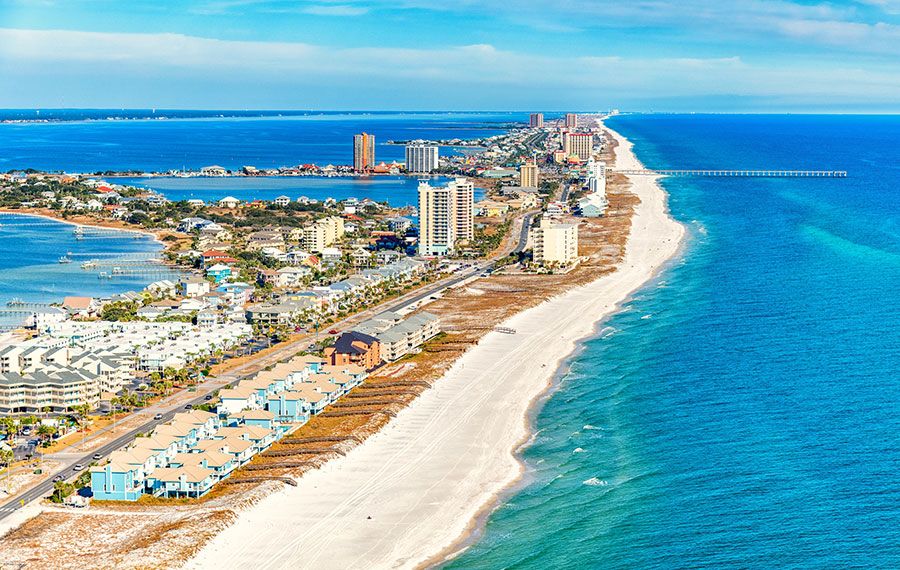
No. By most objective measures, Pensacola Beach ranks among the best beaches in the United States — regularly appearing in national rankings alongside beaches that cost dramatically more to live near.
What makes Pensacola Beach's quality genuine:
The sand: The quartz-white sand on Santa Rosa Island is the same geological formation as Destin and 30A — ancient Appalachian quartz transported by rivers to the Gulf Coast over millions of years. It doesn't stain your feet. It stays cool in the summer heat. It's beautiful in a way that Atlantic beaches and even other Florida Gulf beaches typically don't match.
The water: The Gulf here is emerald green and clear, with a calmness that makes it ideal for swimming, snorkeling, and paddling. The water is warm (mid-80s in summer), and visibility is exceptional compared to Atlantic beaches where currents carry sediment.
The preservation: Gulf Islands National Seashore protects significant stretches of Santa Rosa Island from development permanently. The natural stretches of undeveloped beach that exist on Pensacola Beach will remain undeveloped — a protection that Destin and 30A's more commercial beachfronts cannot claim.
The comparison to Destin specifically: The same Gulf of Mexico, the same geological sand formation, the same emerald water. Side by side, a beach expert couldn't reliably distinguish Pensacola Beach from Destin's best stretches. The price difference is not about beach quality — it's about how much of the market has priced in that quality.
The City Behind the Beach
This is where Pensacola separates from pure resort markets in ways that matter deeply for people who actually live there year-round.
Pensacola is a real city. Not a large city — 55,000 in the city limits, 500,000+ in the metro — but a city with the infrastructure that actual daily life requires:
Healthcare: Two full-service hospital systems (Baptist Health Care and Ascension Sacred Heart), including the only dedicated children's hospital in the region. Specialist networks in cardiology, oncology, orthopedics, and other specialties. This doesn't exist in Destin. You drive to Fort Walton Beach or Pensacola for hospital care when you live in a resort town.
Cultural life: Downtown Pensacola on Palafox Street is a genuine dining and entertainment district — locally owned, year-round, and genuinely good by any standard. The Saenger Theatre, the Museum of Art, the National Naval Aviation Museum (one of the finest aviation museums in the world and free), the growing arts community. None of this is resort-oriented — it's a real city's cultural infrastructure.
Education: University of West Florida anchors a research and tech community. Santa Rosa County schools are consistently top-ranked in Florida. These are institutional assets that pure beach towns lack.
Community: Pensacola has genuine multi-generational community. People have lived here for generations. The military culture adds a specific ethos of service, competence, and community. The result is a city that feels like a place rather than a product.
Living in Destin or on 30A means living in a market built around accommodating visitors. Living in Pensacola means living in a real community that happens to have extraordinary beach access.
The Tax Advantage: Staying in Florida
All of these markets except Virginia Beach and Myrtle Beach are in Florida — so income tax benefits apply equally to all of them. But buyers comparing Pensacola to markets in the Carolinas (Myrtle Beach, Charleston), Virginia, or other states with income taxes need to factor Florida's no-income-tax advantage into their comparison.
For a household earning $100,000, the difference between Florida and South Carolina (up to 6.5% state income tax) is $6,500/year. Between Florida and New York or California, it's significantly more. This ongoing benefit doesn't disappear just because you've moved to the Southeast.
Within Florida, all markets are equal on income tax — the comparison shifts entirely to housing costs and lifestyle quality, where Pensacola maintains its advantage.
The Stability Argument: What Anchors Pensacola's Value
Part of what makes Pensacola a better long-term investment than many comparable beach markets is the economic stability that comes from its military anchor.
NAS Pensacola is a permanent, mission-critical installation. It employs thousands directly and supports thousands more through contracting, services, and the broader military economy. The military demand for housing doesn't evaporate when mortgage rates rise or when the broader economy slows. It creates a consistent, non-discretionary baseline of housing demand that pure resort and tourist markets lack.
Destin's housing market is heavily influenced by vacation home and investment demand — demand that is discretionary and more sensitive to economic conditions. When wealthy buyers pull back on second homes, resort markets can correct more sharply. Pensacola's military-anchored primary residence market is more resilient.
This stability has a track record: in the 2008–2011 housing downturn, Pensacola's decline was more modest than Destin's. In the 2020–2022 surge, Pensacola appreciated strongly. In the post-2022 normalization, Pensacola's correction has been mild. The military anchor smooths the cycles in ways that comparable markets can't replicate.
The Discovery Discount: Still Getting In Early
Markets that have been fully discovered — that appear in every "best beach" and "top retirement" article in national media — have fully priced in their quality. The buyers in those markets pay for something that everyone already knows is valuable.
Pensacola is still in the discovery phase. It appears regularly in "hidden gem" and "most undervalued beach city" articles — not because it lacks quality, but because it hasn't yet fully priced its quality into the market. The national profile continues to rise: Gulf Shores and Destin buyers who've been priced out are looking west; California and Northeast remote workers are landing here; retirement-focused publications are increasingly featuring it.
The buyers who get in during the discovery phase capture appreciation that later buyers miss. Pensacola in 2026 isn't as early as 2019 — the pandemic surge already brought a large wave of discovery buyers. But it's earlier than it will be in 2031 or 2036 as the market continues to mature.
What Pensacola Doesn't Offer: Honest Acknowledgment
The case for Pensacola is genuine and strong — but intellectual honesty requires acknowledging what it doesn't have:
It's not Destin Harbor. The specific waterfront entertainment district of Destin Harbor — marinas, sunset cruises, restaurants over the water, the concentrated resort energy — doesn't exist in Pensacola. The downtown Pensacola waterfront is developing, but it's a different character.
It's not 30A. The specific curated beauty of Seaside, Rosemary Beach, and the 30A corridor — planned communities with architectural codes, boutique retail, and a very specific aesthetic — doesn't exist near Pensacola. That experience costs $800,000–$2,000,000+ for good reason; it's not replicated here.
It's not Sarasota's arts scene. Sarasota has a more developed cultural infrastructure — ballet, opera, major museums, a long-established wealthy retirement community with the arts patronage that brings. Pensacola's cultural life is genuine but smaller.
It doesn't have the entertainment depth of a major metro. This has been consistent throughout this series: Pensacola is a mid-sized city. The variety of restaurants, entertainment, and cultural options reflects that.
For buyers who specifically require what Destin, 30A, or Sarasota uniquely offers — and can afford it — those markets may be the right choice. For buyers who value world-class beach access, genuine community, city infrastructure, and financial accessibility, the choice points clearly toward Pensacola.
The Value Proposition in a Single Statement
If you want Gulf Coast beach living at the highest quality-to-cost ratio available in the United States in 2026 — world-class beach, real city infrastructure, strong schools, stable economy, no income tax, genuine community — Pensacola is the answer.
That's not marketing language. It's what happens when you run the comparison honestly across price, beach quality, city infrastructure, economic stability, and tax environment simultaneously. Pensacola wins that comparison consistently, and it has been winning it for years while the rest of the market catches up to knowing it.
The question isn't whether Pensacola beats other beach markets. It does. The question is whether you're the kind of person who values what Pensacola specifically offers — and whether you'll act on it before the rest of the market prices that value in.
Ready to See the Value for Yourself?
Sean and Shaunda Killingsworth have helped buyers from markets across the country discover what Pensacola offers — and find the specific properties that deliver the best of what this city has. Let's talk about what the right Pensacola fit looks like for you.
Sean & Shaunda Killingsworth Engel & Völkers Pensacola 190 South Jefferson Street, Pensacola, FL 32502 📞 +1 850-332-2457 ✉️ killingsworthhomes@gmail.com 🌐 movingtopensacolabeach.com
If you're relocating to Northwest Florida, let's talk.
Categories
Recent Posts